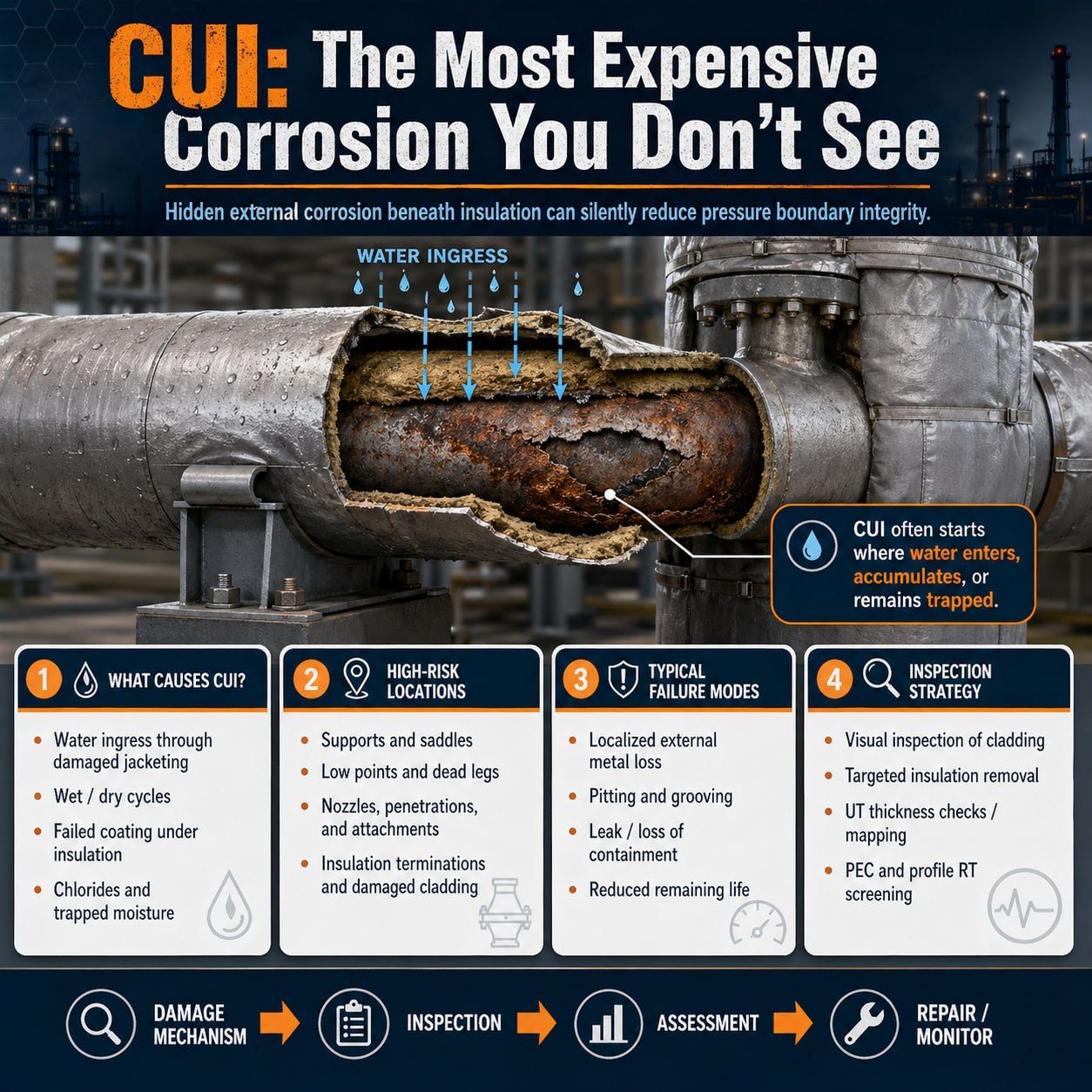
CUI: The Most Expensive Corrosion You Don’t See
Corrosion Under Insulation (CUI) is one of the most underestimated damage mechanisms in oil & gas, petrochemical, and power facilities.
Not because engineers don’t know it exists.
But because it hides behind insulation until the damage has already developed.
And by the time it is visible externally, the equipment may already be close to loss of containment.
—
### 🔹 What Is CUI?
CUI is external corrosion that occurs when water enters the insulation system and remains trapped against the metal surface.
The insulation does not cause corrosion by itself.
The real problem is:
* Water ingress
* Damaged jacketing
* Poor sealing
* Chlorides or contaminants
* Repeated wet/dry cycles
* Failed coating under insulation
Once moisture reaches the pipe or vessel surface, the insulation becomes a corrosion trap.
—
### 🔹 Damage Mechanism First
Damage mechanism: External corrosion under insulation
Affected equipment: Piping, vessels, exchangers, tanks, supports, nozzles
Typical morphology: Localized external metal loss, pitting, grooving, coating breakdown
Failure mode: Leak, rupture, or loss of pressure boundary integrity
This is why CUI cannot be treated as “general corrosion.”
It is often localized, unpredictable, and highly dependent on insulation condition and water retention.
—
### 🔹 Where CUI Usually Starts
CUI rarely starts in the easy-to-inspect locations.
It starts where water can enter, accumulate, or remain trapped:
* Insulation joints
* Damaged jacketing
* Support locations
* Low points
* Termination points
* Nozzles and attachments
* Dead legs
* Vents and drains
* Flanges and valve bodies
* Areas near steam tracing
* Penetrations through insulation
The most dangerous locations are not always the most corroded-looking ones.
They are the locations where water has been sitting unnoticed for years.
—
### 🔹 Why CUI Is Expensive
CUI is expensive because it attacks three things at the same time:
1. Equipment integrity
Wall loss reduces pressure containment capacity.
2. Inspection budget
Full insulation removal is costly and time-consuming.
3. Production availability
Repairs are often discovered late, during shutdowns, when schedule pressure is already high.
The real cost of CUI is not only the repair.
It is the unplanned shutdown, scaffolding, insulation removal, coating repair, replacement material, hydrotest decision, and production interruption.
—
### 🔹 Common Mistake
The biggest mistake is assuming:
> “The insulation looks fine, so the pipe is fine.”
This is not engineering.
This is visual comfort.
CUI must be assessed based on risk, operating temperature, coating condition, insulation type, water exposure, inspection history, and consequence of failure.
—
### 🔹 Inspection Strategy
A serious CUI program should combine:
* External visual inspection of insulation condition
* Risk-based selection of inspection locations
* Targeted insulation removal
* UT thickness measurement
* Corrosion mapping
* Profile radiography where access is limited
* Pulsed Eddy Current (PEC) for screening
* Guided wave UT for long piping runs
* Follow-up confirmation by direct UT
Screening tools can identify suspect areas.
But final integrity decisions require reliable wall thickness data.
—
### 🔹 What is RBI Logic for CUI
Not every insulated line has the same risk.
A proper RBI approach considers:
– Probability of Failure:
* Temperature range
* Insulation condition
* Coating age
* Water exposure
* Previous CUI history
– Consequence of Failure:
* Fluid toxicity
* Flammability
* Pressure
* Location
* Personnel exposure
* Environmental impact
High CUI susceptibility + high consequence service = inspection priority.
—
### 🔹 Engineering Decision
When CUI is found, the decision should not be emotional. It should follow this logic:
1. Confirm damage mechanism
2. Validate inspection data
3. Define corrosion extent
4. Calculate remaining thickness
5. Compare against required thickness
6. Evaluate remaining life
7. Perform FFS if required
8. Decide: monitor, repair, replace, or rerate
■ For localized metal loss, API 579 Part 5 may be required.
■ For general metal loss, API 579 Part 4 may apply.
Wrong damage classification leads to wrong decisions.
—
### 🔹 Practical Field Recommendations
* Do not inspect only where insulation is already damaged
* Do not rely only on visual inspection
* Increase inspection at supports and low points
* Verify coating condition, not only wall thickness
* Replace wet insulation immediately
* Seal terminations properly
* Use stainless steel jacketing carefully where chloride risk exists
* Document CUI findings into RBI and CML strategy
* Reinspect repaired areas; coating repair is not permanent protection
—
### 🔹 Final Message
CUI is not just a corrosion problem. It is an operation and integrity management problem.
The equipment may look normal from outside, while the pressure boundary is losing strength underneath the insulation.
That is why CUI requires:
* Damage-mechanism understanding
* Risk-based inspection
* Correct NDT selection
* Conservative remaining life assessment
* Strong field execution
—
CUI does not fail because it is unknown. It fails because it is underestimated.
And in asset integrity, the most dangerous corrosion is often the corrosion you cannot see.
#AssetIntegrity #CorrosionEngineering #CUI #API571 #API510 #API570 #API579 #RBI #Inspection #MechanicalIntegrity #OilAndGas


Leave a Reply